
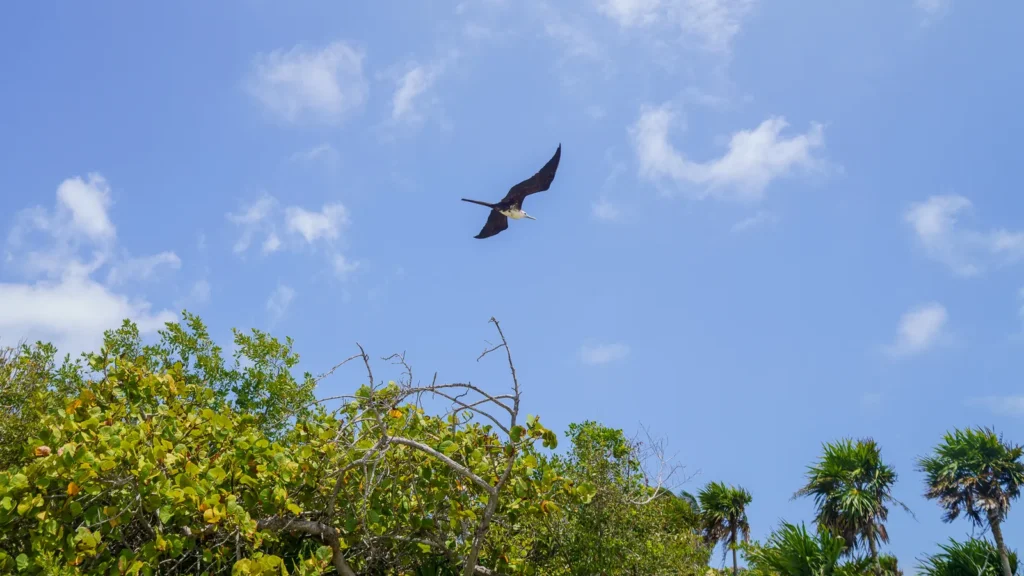
Look up almost anywhere along the coast of Sian Ka’an and sooner or later you will see it: a black silhouette with long, angled wings and a deeply forked tail, hanging in the sky without a single wingbeat. It is the magnificent frigatebird, and once you know it, you will never confuse it with anything else.
How to Recognise a Frigatebird
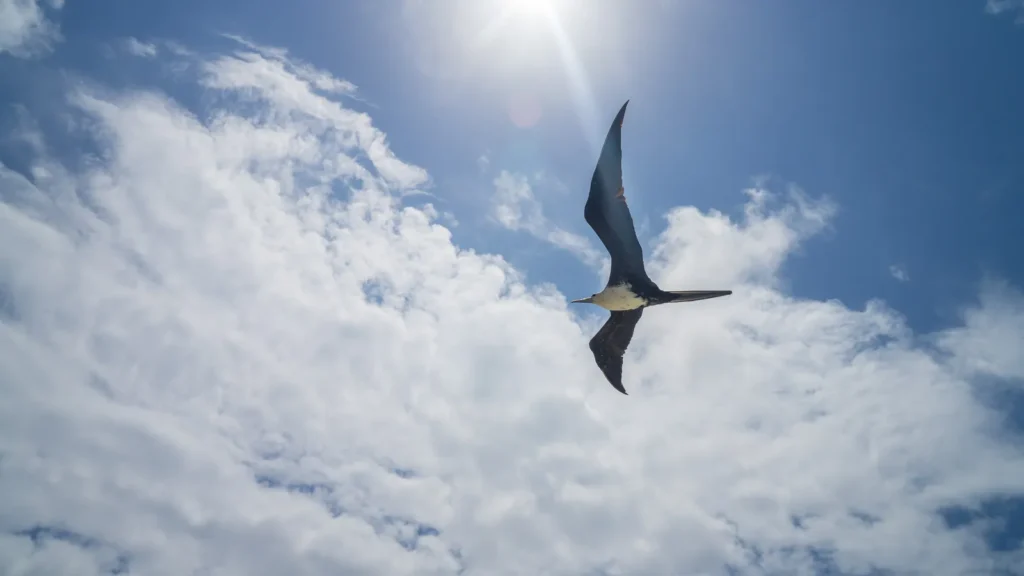
- Shape: long, narrow wings bent at the wrist like a stretched letter M, and a long forked tail that opens and closes like scissors.
- Size: a wingspan of more than two metres, with a surprisingly light body.
- Flight: it soars for long periods on thermal air currents, rarely flapping.
- Colours: adult males are glossy black and, in breeding season, inflate a bright red throat pouch. Females have a white chest. Young birds have white heads.
The Pirate of the Caribbean Sky
Frigatebirds feed at sea, but their feathers are not fully waterproof, so they avoid landing on the water. Instead they snatch fish and squid from the surface in flight, and they have a famous habit: chasing other seabirds, such as boobies and gulls, until they drop their catch, and then grabbing it in mid-air.
This behaviour, called kleptoparasitism, earned them the nickname “pirate birds”. In reality, most of their food comes from their own fishing. But watching a frigatebird chase down another bird over the lagoon is unforgettable.
Where to See Frigatebirds in Sian Ka’an
Frigatebirds are common along the Caribbean coast of Quintana Roo all year. In Sian Ka’an, the best views come near the sea, where the lagoons open to the Caribbean. On the full-day Ancient Canal Tour, the stretch toward Boca Paila often has several frigatebirds circling overhead. Read more about that part of the route in our article on Boca Paila.
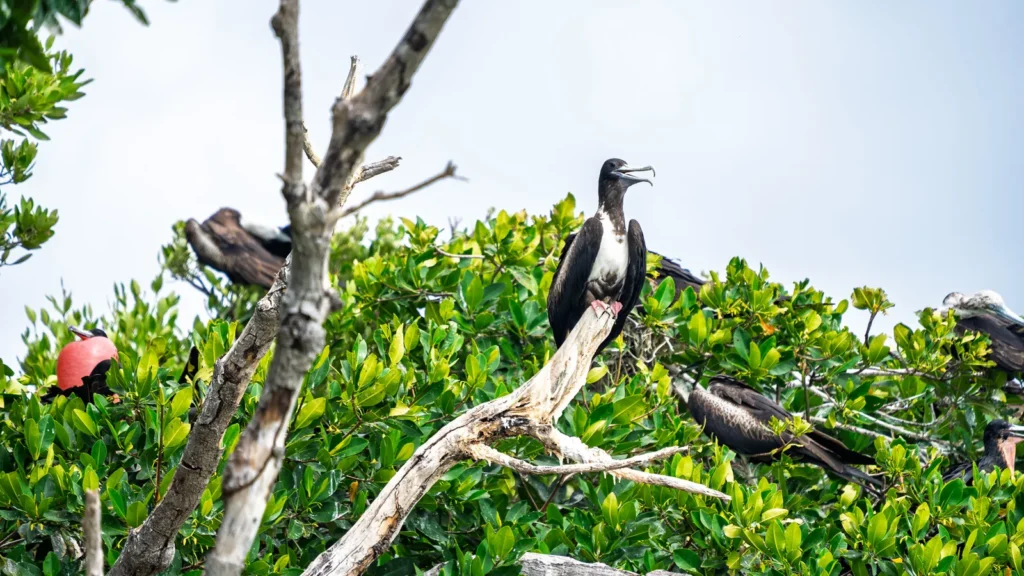
They also roost and nest on mangrove islands, where you may see groups perched on dry branches. These colonies are sensitive to disturbance, so we always keep our distance.
The Red Pouch
The most spectacular frigatebird display is the male’s red throat pouch, inflated like a balloon to attract females during courtship. It can take several minutes to inflate and stays that way while the male waits on the nest site, sometimes for hours. If you are lucky enough to see one, you are watching one of the most striking courtship displays of any seabird.
Watching Responsibly
- Keep your distance from roosts and nesting colonies.
- Never try to feed seabirds.
- Use binoculars or a zoom lens instead of getting closer.
- Follow your captain’s lead: they know where birds are sensitive.
Frigatebirds are just one of the many species of the region. Explore more in our guide to the wildlife of Sian Ka’an or our birding season guide. To see the coast from the water, book the Ancient Canal Tour in Sian Ka’an with our Maya cooperative.
Meet the Maya Cooperative Behind Your Visit
Frequently Asked Questions
Why is the frigatebird called a pirate bird?
Because it often chases other seabirds until they drop their food and then catches it in mid-air, a behaviour known as kleptoparasitism.
Can frigatebirds land on water?
They avoid it. Their feathers are not fully waterproof, so they feed by snatching prey from the surface while flying.
Where can I see frigatebirds near Tulum?
Along the coast and over the lagoons of Sian Ka’an, especially near Boca Paila on the Ancient Canal Tour.
Questions? Contact us at reservacionesctsk@siankaantours.com.mx or WhatsApp +52 984 114 0750