
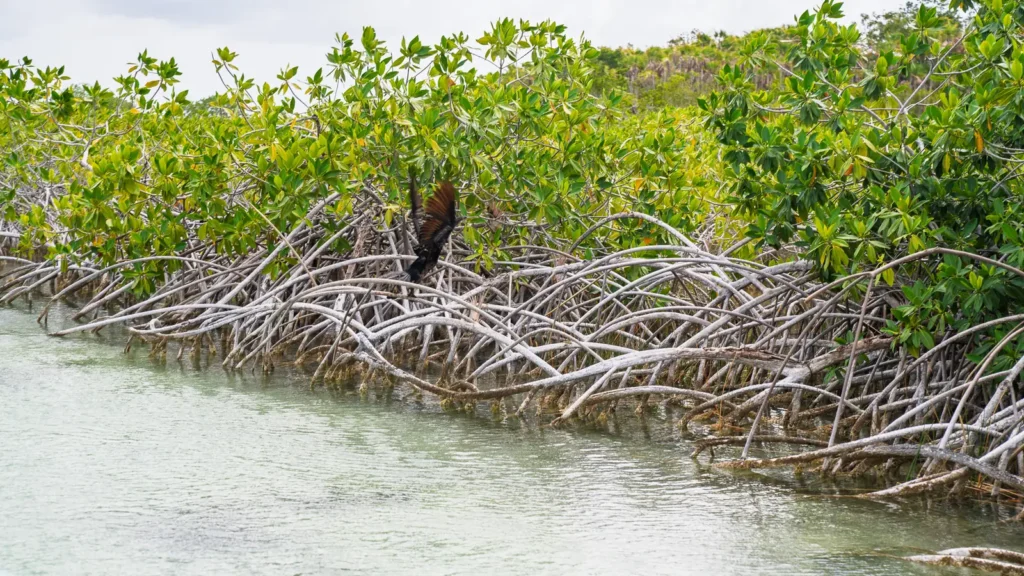
Halfway along the lagoon, a dark bird sits on a mangrove root with its wings spread wide, like a cape hung out to dry. Someone in the boat asks: “Is that a cormorant?” Sometimes it is. Sometimes it is an anhinga. With a few simple clues, you can tell the difference in seconds.
Why They Spread Their Wings
Both birds hunt underwater, chasing fish below the surface. To dive easily, their feathers are less water-repellent than those of ducks, so they get soaked. After fishing, both perch in the sun with wings open to dry and warm up. That shared habit is why people confuse them.
How to Tell Them Apart
- Bill: the anhinga has a long, straight, dagger-pointed bill used to spear fish. The cormorant has a shorter bill with a hooked tip, used to grab them.
- Neck: the anhinga’s neck is very long and thin, often bent in an S-shape. That is why it is nicknamed the “snake bird”. The cormorant’s neck is thicker and shorter.
- Tail: the anhinga has a long, fan-shaped tail. The cormorant’s tail is shorter.
- Wing pattern: adult anhingas show silvery white streaks and spots on their back and wings. Cormorants are more uniformly dark.
- Swimming: an anhinga often swims with only its head and neck above water, looking like a snake moving through the lagoon. A cormorant floats with more of its body visible.
Two Ways of Fishing
The anhinga is a stalker. It moves slowly underwater and, with a sudden thrust of its neck, spears a fish with its sharp bill. Then it surfaces, flips the fish into the air and swallows it headfirst.
The cormorant is a pursuer. It swims fast underwater, propelled by its feet, and catches fish with its hooked bill. Cormorants often fish in groups, especially in open lagoons.
Where to See Them in Sian Ka’an
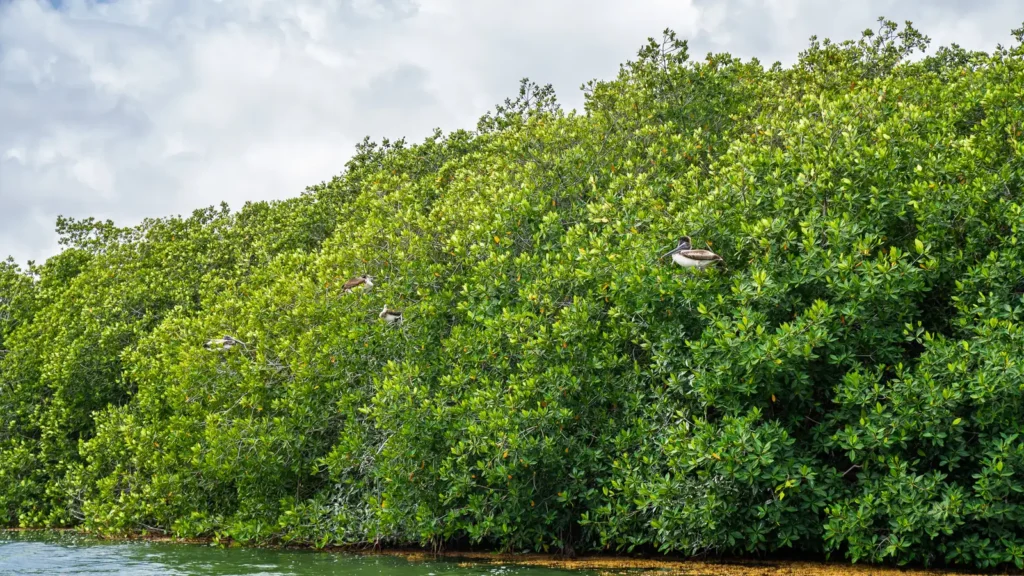
Both species are common on the lagoons of Sian Ka’an, perched on mangrove roots or snags close to the water. On the Ancient Canal Tour you will often see them on the way to Capelchén Lagoon and Boca Paila, and paddlers on our kayak tour sometimes pass within a few metres of them on Muyil Lagoon.
Mangrove roots are their favourite perches, which is one more reason those trees matter. Learn more in our article on the mangroves of the Riviera Maya.
A Small Lesson in Looking
Telling an anhinga from a cormorant is a good example of what birdwatching teaches: to look carefully at shape, behaviour and details instead of just colour. Our guides love these questions. Ask them on the boat, and you will leave the lagoon seeing more than you expected.
Meet the Maya Cooperative Behind Your Visit
Frequently Asked Questions
What is the difference between an anhinga and a cormorant?
The anhinga has a long, straight, pointed bill, a thin snake-like neck and a long fan-shaped tail. The cormorant has a hooked bill, a thicker neck and a shorter tail.
Why do anhingas and cormorants spread their wings?
Their feathers get wet when they dive, so they perch in the sun with open wings to dry and warm up.
Can I see anhingas on Sian Ka’an tours?
Yes, both anhingas and cormorants are common on the lagoons and mangroves, although sightings are never guaranteed.
Questions? Contact us at reservacionesctsk@siankaantours.com.mx or WhatsApp +52 984 114 0750