
Just 20 minutes south of Tulum, hidden inside a UNESCO biosphere, sits one of the oldest Maya cities on the Yucatan Peninsula — and one of the least visited. The Muyil ruins (also known as Chunyaxché) are often dismissed as a minor late-period settlement. The ground says otherwise: people have lived here for more than 2,000 years, this was a major city building in the style of Tikal while Tulum was still nothing, and the community that descends from its builders is still here today.
In this guide, we cover what recent archaeology has revealed, what you’ll see on site, how Muyil compares to Tulum and Cobá, how to visit, and why the archaeological zone is only half the story — the other half flows through the lagoons and the sacred canal just beyond the temples.
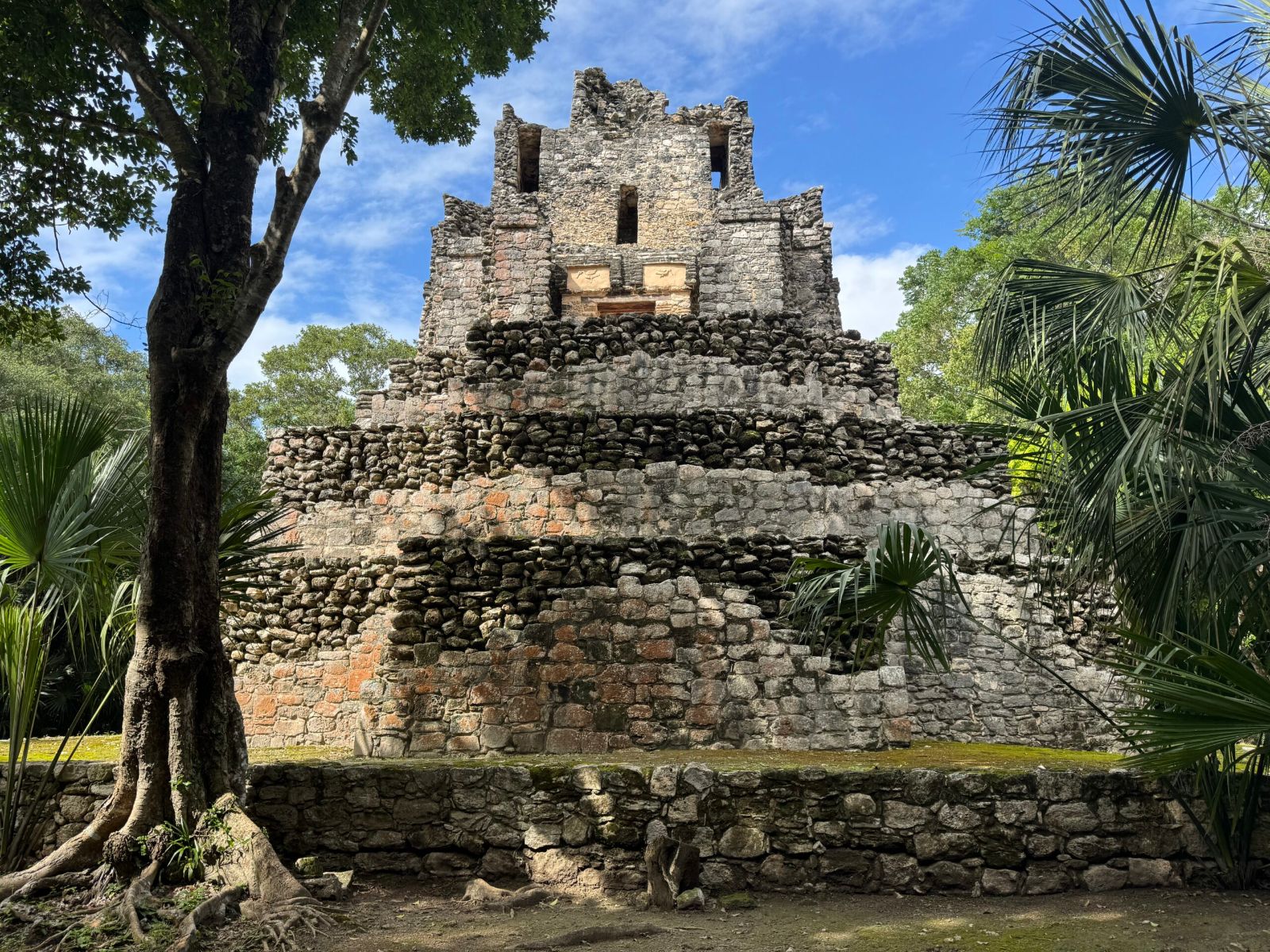
What Is the Muyil Archaeological Zone?
A quick note on language: throughout this guide you’ll see the term “Muyil ruins,” because that’s how most travelers search for the site. But ruins undersells what you’ll actually find. Muyil is an archaeological zone — a protected, studied, and remarkably well-preserved ancient city. For the Maya community that descends from its builders, these are not the remains of a lost world but the living heritage of a culture that is still very much here. We’d be lucky if our own modern cities were one day preserved in such condition. We’ll call it an archaeological zone throughout — and invite you to see Muyil that way too.
Muyil sits inside the Sian Ka’an Biosphere Reserve, at a strategic point where inland jungle meets a chain of lagoons that connected the Maya world to the Caribbean Sea. At least 290 structures have been mapped here, and its chronology runs from the Late Preclassic all the way to the present day — with phases in which parts of the city were abandoned and later reoccupied, sometimes rebuilt with stone recycled from the older buildings.
That makes Muyil unusual among Maya sites: it was never fully depopulated. The archaeological zone is administered by INAH, Mexico’s National Institute of Anthropology and History, and has been studied since the 1980s — most recently through the work of archaeologist Enrique Alcalá, who has led research here since 2012.
One more thing about the name, because it explains a lot. Nobody knows what this city was called. Its original Maya name was never recovered — no inscription, no colonial record preserved it. So during the Viceroyalty the site was simply associated with the lagoon beside it, and that borrowed name stuck: Muyil. And Maya speakers today identify the word Muyil as meaning “place of ruins.”
So the name we use is a placeholder twice over — a lagoon’s name, standing in for a lost one, describing what outsiders saw rather than what the place was. Which is worth remembering as you walk it. The city had a name once. The people who might have known it are still here.
New Discoveries: How Archaeology Rewrote Muyil’s History
Muyil recently underwent the most significant archaeological intervention in its modern history, through PROMEZA (Mexico’s Archaeological Zone Improvement Program), which was applied across 11 sites in Quintana Roo. Four archaeologists excavated at Muyil under the coordination of archaeologist Enrique Alcalá, combining deep excavation with cutting-edge digital survey. What they found changed the story of the site:
- A much deeper chronology — Muyil is often described as a Late Postclassic “East Coast style” site, because most of its smaller visible buildings date from 1300–1550 CE. That’s only the final chapter. Ceramic evidence officially places people here from around 300 BCE, and by the Classic period (600–950 CE) Muyil was already a major city building in the Petén style of the Guatemalan lowlands — the tradition of Tikal — including El Castillo itself. Here’s the part the signs don’t say yet: recent excavation has turned up evidence pointing to occupation as early as 350 BCE. It’s still under study and not yet official, which is exactly why it’s worth hearing from a guide who was there when it came out of the ground.
- LIDAR revealed the true scale of settlement — Laser scanning along the region’s development corridor registered roughly 15,000 previously unknown structures across the surveyed periphery, showing that ancient occupation here was far denser than anyone had mapped.
- Two entirely new complexes opened to visitors — The Sacbé Group and the Great Platform Group were excavated and incorporated into the public route, significantly expanding what you can see.
- The first burial ever found at Muyil — Human remains of an adult between 30 and 40 years old, accompanied by ceramic offering vessels containing the bones of birds and rodents. The analysis is still ongoing — bones are, as archaeologists put it, the cash register of a population’s health and diet, and this one is still being read.
- A temazcal and a ritual “closing” offering — Archaeologists found a Maya steam bath with drainage channels and layers of ash. Beneath a stone slab lay an abandonment offering: a cup bearing the face of a ruler, jade, and a necklace of Spondylus shells from the Pacific coast — hard evidence of long-distance trade. The abandonment of this complex wasn’t collapse; it was planned and ritualized.
- Muyil in the Caste War — The site’s story doesn’t stop with the ancient Maya. During the Caste War (1847–1901), the long uprising of the Maya against the Peninsula’s white population, Muyil was occupied again. The evidence is albarradas — low dry-stone walls built from blocks pulled out of the pre-Hispanic buildings and stacked without mortar. One of the best-preserved albarradas at the site is here, and around it archaeologists recovered a pair of horseshoes and low-caliber bullets. Maya rebels sheltering in a Maya city their ancestors built, a thousand years later.
The Port of the Lowlands: Muyil’s Maritime Economy
Here’s the finding that reframes everything: excavators recovered more than 300 ceramic fishing-net weights, along with remains of fish from both fresh and salt water, turtles, and stone fishing tools. The conclusion is that roughly 80% of Muyil’s economy was maritime.
Muyil wasn’t primarily a ceremonial showpiece — it was a working customs house and supply hub, the logistical port that fed great inland cities like Cobá and Chichén Itzá. Salt, jade, cacao, obsidian, copal, and fish moved through here, along the lagoons and out to the Caribbean. When you stand in the plaza, you’re standing in a port.
What You’ll See at the Muyil Archaeological Zone
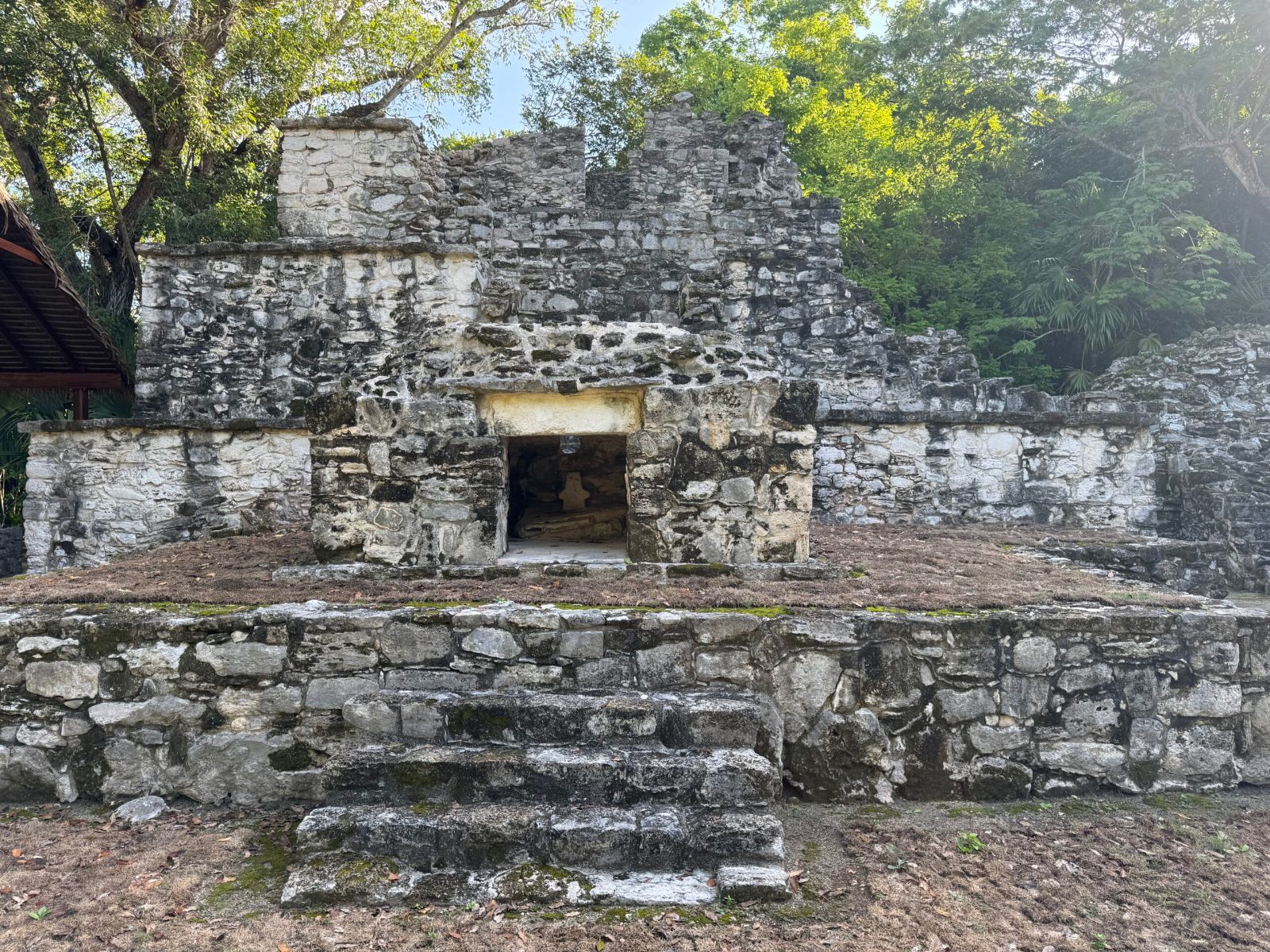
- El Castillo — At 17 meters, the tallest building in Muyil, built in the Petén style with recessed corners and steep vertical bodies. It was raised in three stages, each temple sealed and buried to build the next one higher. On the altar at the top of its staircase, archaeologists found a rich offering of globular green stone beads and marine shell. Crowning it all is a cylindrical structure unlike anything else at the site — and here’s the honest part: nobody knows what it was for. Guides will tell you the most compelling hypothesis, that it served as a beacon for navigators arriving through the lagoons, but INAH lists its function as undetermined. You get to stand there and wonder.
- Temple 8, in the Pink Group — Built during Muyil’s most intense construction phase, the Late Postclassic (1300–1550 CE), in East Coast style. It stands on an earlier building — and beside its staircase is a small tunnel that leads into the interior of the previous temple, an access probably tied to some important ceremonial event. It’s sealed today, but on the east side an “archaeological window” lets you see the wall of the older temple with the newer one built directly over it. Two eras, one wall.
- The bird reliefs — Muyil’s emblem — Two stucco birds set high on the temple facade that looks toward the lagoon. They have their own story, below.
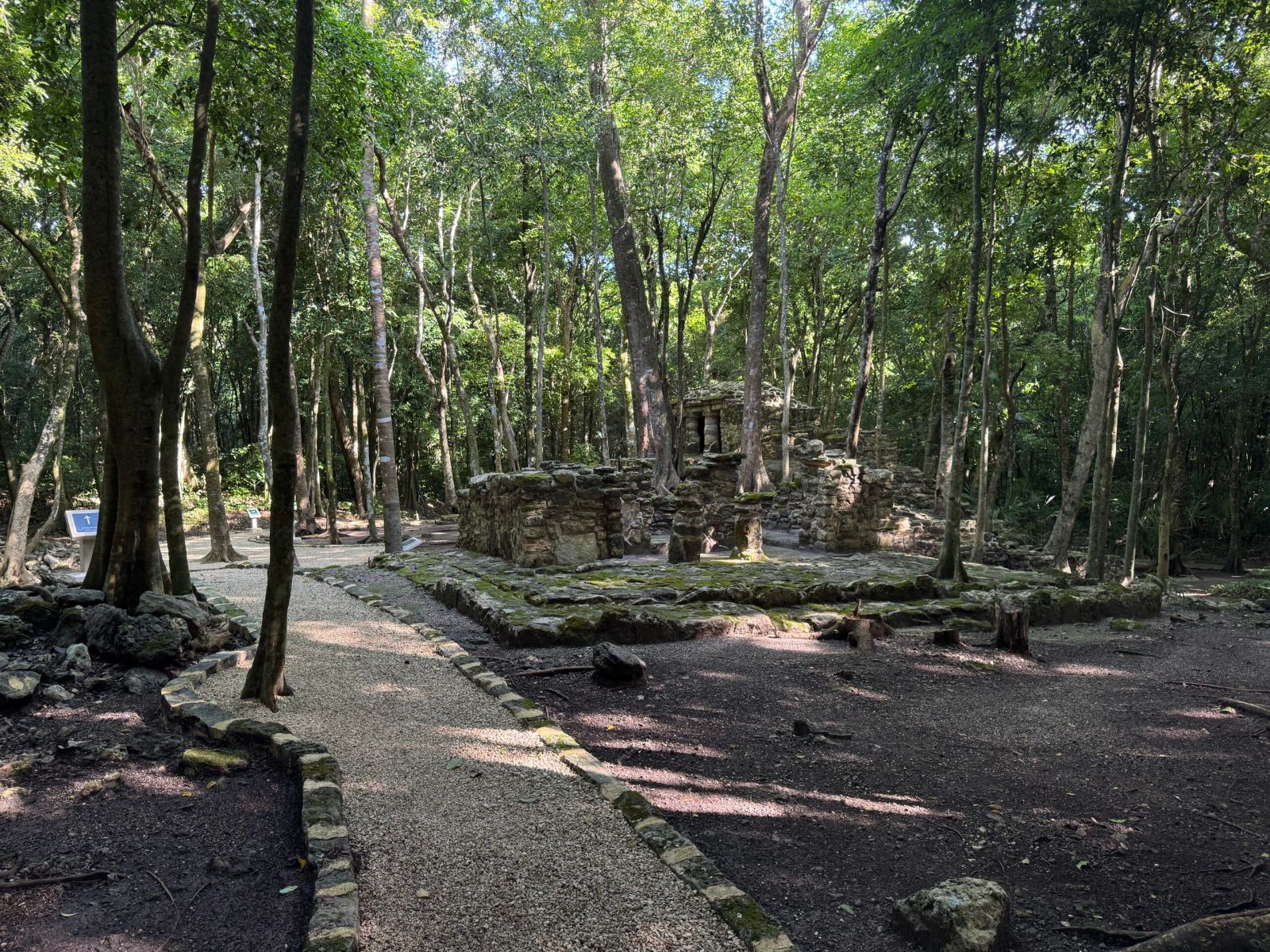
- The Group of the Entrance — The site’s main plaza, made up of 14 structures and used as a ceremonial gathering space. The taller pyramidal buildings date to the Early Postclassic (950–1200 CE); the smaller East Coast–style ones in front of them were added centuries later (1300–1550 CE), possibly to consecrate the same deities the originals were dedicated to — later generations building in front of their ancestors rather than over them.
- The Sacbé Group — the oldest, and a crime scene — Named for the Maya sak bej, “white road.” This is likely the site’s first civic-ceremonial space, in use from the Late Classic (600–900 CE), older than the main plaza. Its architecture is strikingly irregular: rounded corners, and staircases that aren’t centered on their buildings. And its temples were destroyed. Archaeologists think the group was abandoned after a conflict — the evidence is Building 4, whose temple held two altars: one was found intact, and of the second, only its imprint remained beneath the rubble. Later generations quarried stone out of these ruined buildings to construct the Entrance Group.
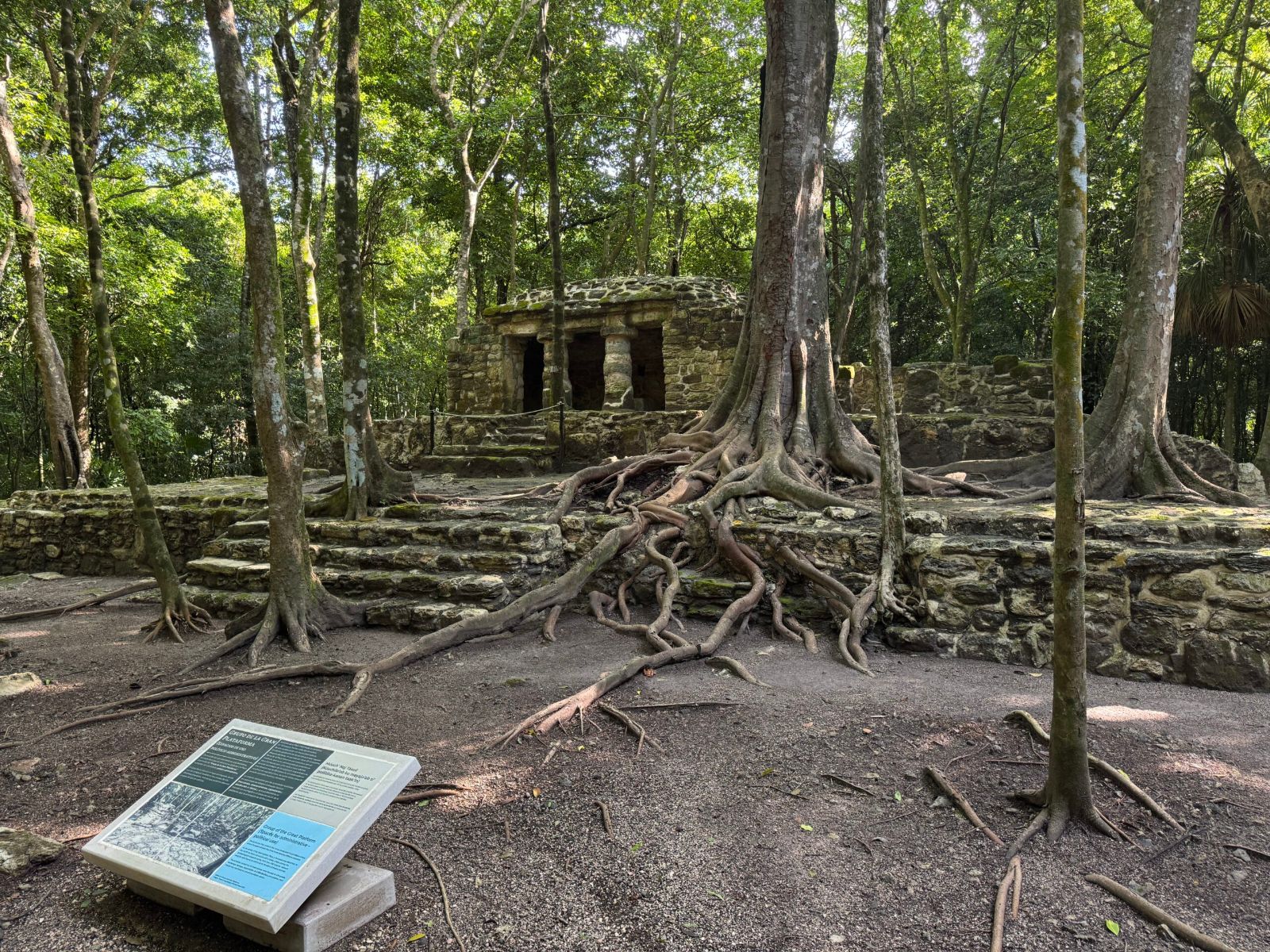
- The Great Platform Group — Newly opened, and read by archaeologists as the site’s political-administrative and residential quarter: three plazas stepped across different levels, on ground reserved for the ruling class. A temazcal (ritual steam bath) with its benches and drainage channel sits in the intermediate plaza, with the foundations of a perishable-walled structure facing it where bathers likely rested afterward. Nearby stands an 18-meter building with two-meter-thick walls, and it was in this group that the 300+ net weights and animal bones were found. Access was restricted to a small sector of the population — you are walking through the offices of a Maya port authority. Excavation also showed the platform grew in stages, which is a way of watching Muyil’s economy expand in slow motion.
- Building 8J-4 and its surviving colors — In the lower plaza of the Great Platform stands a building carrying two temples used at different times: a smaller southern one with two altars inside, and a larger northern one with three entrances divided by two columns under a vaulted roof. During restoration, that vault was deliberately saved in order to protect what’s underneath it — a series of painted motifs still preserved on the stucco of the back wall, in black, red, yellow, and Maya blue, the famously durable pigment the Maya invented. Every building here was once fully stuccoed and painted like this. The grey stone you see across the site is the exception, not the rule.
- A Descending God — A collapsed figure of this deity was found, originally mounted above a doorway.
- The original Sacbé floor — A preserved fragment of the ancient white road, its lime stucco still smooth and cool. It was polished to be walked barefoot, and under moonlight it glowed — a night highway that needed no lamps.
The Two Birds That Watch the Lagoon
Walk around to the back of El Castillo — the side facing the lagoon — and look up. You’ll see two birds modeled in stucco mortar, ornamenting the top of a doorway. Most visitors walk right past them, and there’s a reason they’re easy to miss: they were never meant to be seen from outside at all.
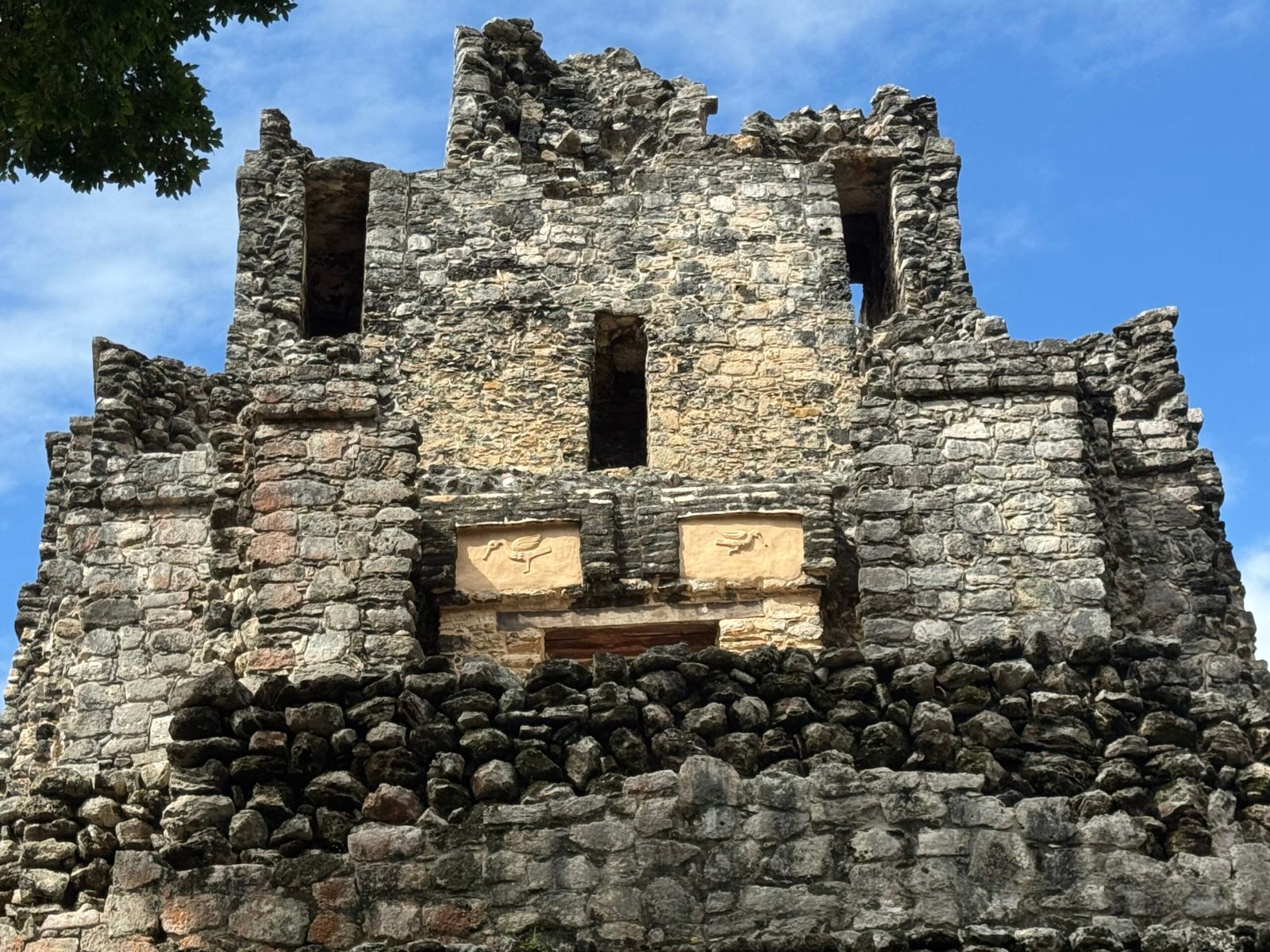
El Castillo was built in stages, each temple sealed and buried beneath the next. These birds decorated the interior doorway of the earliest temple — sealed inside the building for centuries. What exposed them was an accident of time: the outer wall of that section collapsed, opening a window into the oldest layer of the pyramid. You are looking at the inside of a building that was closed a thousand years ago.
The birds are identified as cormorants — diving fishing birds still common in these lagoons today (the species is likely the Neotropic cormorant, Phalacrocorax brasilianus). The identification is careful rather than certain, but it fits everything else the ground has revealed. In the Great Platform Group, archaeologists recovered more than 300 ceramic fishing-net weights alongside the bones of marine animals. Put the two findings together and the birds stop being decoration: they are a fishing city’s self-portrait, set above a doorway by people who lived from the catch.
Ancient Engineering: Astronomy, Hurricanes & Architecture That Breathes
Muyil’s builders were reading the sky and the weather with the buildings themselves. The architecture marks the equinoxes and solstices — light and shadow play across the stairways at the spring equinox and again in September. Guides here will also show you the small openings in the towers and explain their role as an early-warning system for hurricanes: when the wind whistled through them a certain way, the community knew a storm was coming and had time to prepare. Thick-walled buildings like the long gallery in the Great Platform doubled as passive cold storage — an ancestral refrigerator keeping fish and grain from spoiling in jungle heat.
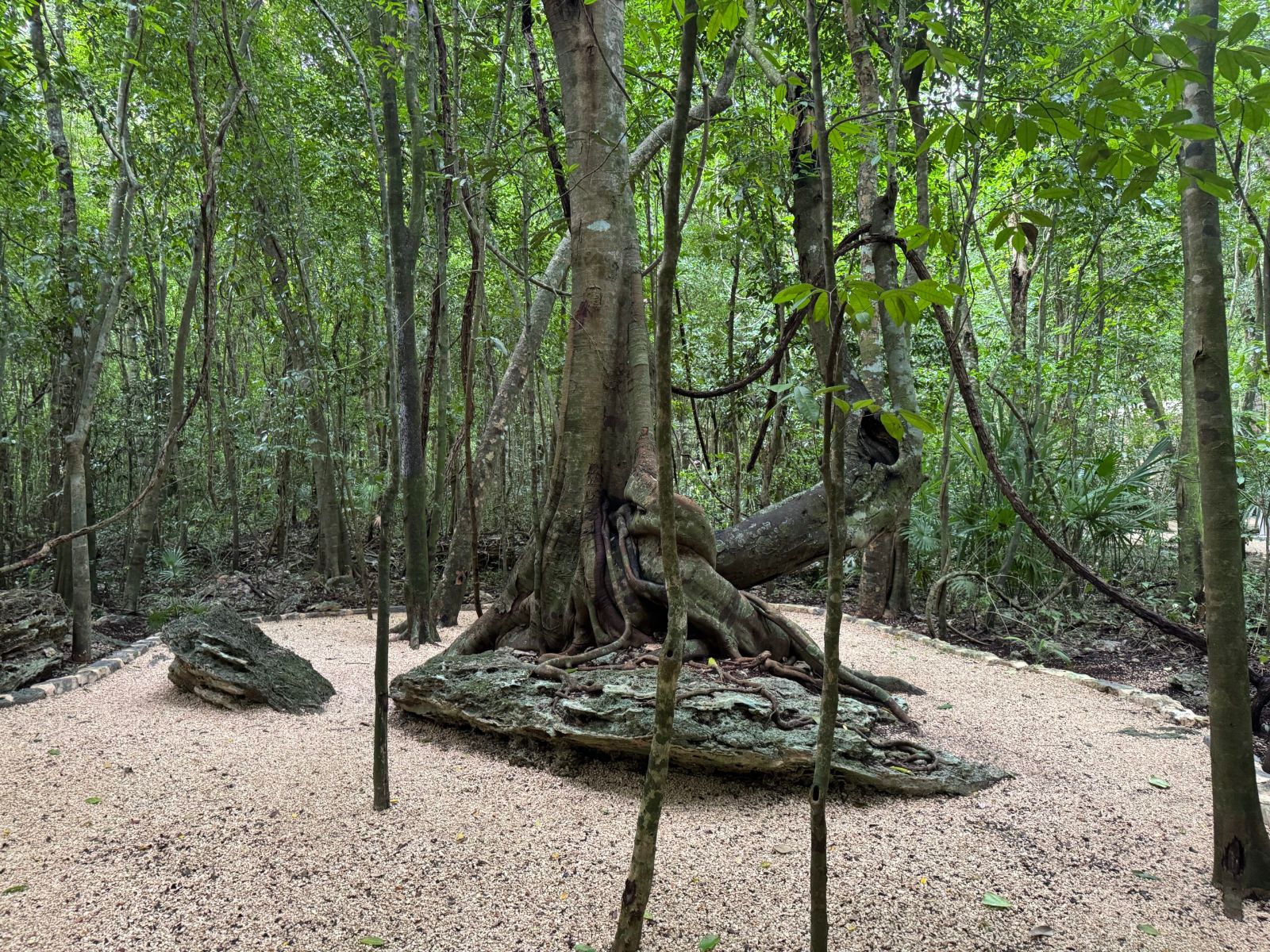
The ground itself shaped what could be built. This whole peninsula is a limestone plain, and where rainwater seeps through cracks it dissolves the rock from below — the process called karst, which is what carves out the cenotes and sinkholes the Yucatan is famous for. Walk the site and you’ll notice the land dip into closed depressions. The Maya read that terrain and built with it, siting their groups on the high ground between the hollows.
That same intelligence guides the site’s conservation today. Restorers deliberately use lime instead of cement, so the structures can breathe and expel humidity rather than trapping it and cracking — the reason some walls look damp is that they’re working exactly as designed. And where modern restoration meets original stone, a technique called rajueleo (setting small stones into the joints) makes the intervention visible, so no visitor mistakes new work for ancient work. New walkways were designed to prevent flooding and allow permanent maintenance without altering the landscape.
Muyil vs. Tulum vs. Cobá: How Is It Different?
- Far fewer crowds — Tulum’s clifftop archaeological zone can see thousands of visitors a day. Muyil often feels nearly empty, even in high season.
- Older and deeper history — Muyil’s occupation begins over two millennia ago and, uniquely, never ends.
- Inside a living biosphere — Muyil is the only one of the three set within the Sian Ka’an Biosphere Reserve, surrounded by protected jungle, lagoons, and wildlife.
- Temples and water in one visit — This is Muyil’s unique advantage: the archaeological zone connects directly to the lagoons and the ancient canal, so a single trip combines temples with a float through Maya trade history.
Beyond the Temples: The Lagoons & the Sacred Canal
Here’s what most day-trippers miss. The Muyil archaeological zone sits at the edge of two connected lagoons — Muyil and Chunyaxché — linked by a canal the ancient Maya engineered centuries ago to move goods between them. Follow that water further and you reach Xlapak, an ancient Maya customs post, and a second, entirely natural canal where visitors slip into the current for a contemplative float beneath the mangroves.
In other words: the temples tell you what the Maya built, and the water shows you how they lived and traded. Seeing only the archaeological zone is like reading half a book. To experience both — the archaeology and the sacred waterways — you need a guided trip that includes lagoon access, which is exactly what our Muyil Sacred Mayan Immersion tour is built around.
A City That Never Emptied: Muyil Today
Most ancient Maya cities are visited as places that ended. Muyil is different: it was never depopulated. Its chronology runs to the present day, and INAH’s own signage states it plainly — the site continues to be used for ceremonial purposes by the ejido of Chunyaxché, because the Group of the Entrance, the ancient main plaza, also holds a modern community cemetery.
Read that again, because it’s remarkable: the plaza where the Maya gathered for ceremonies a thousand years ago is still the plaza where this community gathers for ceremonies and buries its dead. Not a reconstruction. Not a revival. The same ground, without interruption.
This is why guiding matters here. The people who show you Muyil are not interpreters of someone else’s past — they are the descendants of the people who built El Castillo, still living beside it, still burying their families in the same ground.
You’ll see small signs of that continuity as you walk. Inside one of the temples of the Group of the Entrance sits a modest carved stone with a quiet offering left beside it — the kind of gesture made for the aluxes, the guardian spirits of the land in Maya tradition. Nobody staged it for visitors. It’s simply what people here have always done.
How to Visit the Muyil Archaeological Zone
Location & Getting There
Muyil is about 20–25 minutes south of Tulum along Highway 307, toward Felipe Carrillo Puerto. You can drive yourself, but there’s no public transport directly to the entrance, and a self-guided visit only gives you the archaeological zone on foot — not the lagoons or the canal, which require a boat and biosphere access. The site’s visitor area has been upgraded with new signage and services.
Entry Fees
There are two separate fees: the INAH archaeological site entry, and a separate Sian Ka’an Biosphere Reserve federal fee (approx. MX$225 / US$14 per person) administered by CONANP if you continue into the reserve and the lagoons. On our guided tour, the archaeological entry is included and the CONANP fee is paid on arrival.
Self-Guided vs. Guided
This matters more at Muyil than at most sites. Much of what makes the zone extraordinary right now — the new chronology, the reused stones, the cormorant reliefs, the meaning of a two-meter wall — is invisible without someone to point it out. A self-guided walk gives you beautiful structures with minimal signage. A guided visit with the local Maya cooperative gives you the archaeology, the cultural meaning, and access to the waterways the city was built around.
The Best Way to Experience Muyil: The Sacred Mayan Immersion
Our Muyil Sacred Mayan Immersion tour is a full 8-hour day designed to show you everything the archaeological zone alone can’t. Led by a Maya guide from this very community —certified under NOM-09-TUR— it combines:
- Round-trip transportation from Tulum and a traditional Maya breakfast & lunch at our palapa
- Guided exploration of the archaeological zone — El Castillo, Temple 8, and the Sacbé groups
- A jungle trail down to the lagoon, then boat navigation through the canal the Maya engineered to connect Muyil and Chunyaxché
- The contemplative float through the natural canal at Xlapak — roughly 950 meters carried by the current
- A walk through the Sian Ka’an savanna, a completely different ecosystem within the reserve
Groups are capped at 6 passengers per boat, keeping the experience intimate. Adult pricing is $2,980 MXN and children 4–12 are $2,660 MXN, not including the CONANP biosphere fee.
Practical Tips for Visiting Muyil
- Go early — Mornings are cooler, quieter, and best for wildlife along the lagoons.
- Bring comfortable walking shoes — The zone and jungle trails are natural, uneven ground.
- Biodegradable sunscreen and repellent only — Conventional products are prohibited inside the biosphere.
- Bring swimwear — If you’re doing the canal float, you’ll want it.
- Cash for the biosphere fee — The CONANP fee is paid on arrival.
Why Book with Community Tours Sian Ka’an?
Community Tours Sian Ka’an is not an agency that resells experiences. We are the community. Every guide, boat captain, and cook is a member of the Maya families of Muyil — people who have lived alongside this ancient city for generations. Our entire organization, from leadership to reservations to kitchen staff, is Maya. When you book directly with us, 100% of the income benefits those families and funds active conservation within the reserve.
Our guides also train directly with the archaeologists working the site, so the story you hear reflects the newest evidence — not a script written a decade ago.
🏆 Tripadvisor Travelers’ Choice Award — Three Consecutive Years (2024, 2025, 2026). Also recognized with the Good Travel Seal Level 2 Silver and featured in the Green Destinations Top 100 Story List for our regenerative, community-based tourism model in Sian Ka’an.
Meet the Community Behind the Tour
In just two minutes, discover who we are — the Maya families and cooperative members who make every experience authentic and regenerative:
Looking to explore more of Sian Ka’an with us? Browse our other community-led experiences:
- Ancient Canal Tour — The 950-meter natural canal float at Xlapak, as its own dedicated experience
- Kayak Tour — Paddle the lagoons yourself through the canal the Maya engineered
- Birdwatching & Mayan Herbal Medicine — Sunrise birding with 350+ species and traditional plant knowledge
Frequently Asked Questions: Muyil Ruins
How old are the Muyil ruins?
Ceramic evidence places people at Muyil in the Late Preclassic, over 2,000 years ago. By the Classic period (600–950 CE) it was already an important city building in the Petén style, including El Castillo. Most of the smaller buildings you see date from the Late Postclassic (1300–1550 CE). And its chronology doesn’t stop there — it continues, uninterrupted, into the present day.
Muyil or Tulum ruins — which should I visit?
Tulum’s archaeological zone is famous for its clifftop setting but is crowded and coastal. Muyil is older, far quieter, set in jungle inside the Sian Ka’an biosphere, and uniquely combines temples with lagoons and an ancient canal. It also has newly opened complexes that most visitors haven’t seen yet. If you want atmosphere, history, and nature in one visit, Muyil is hard to beat.
Can you climb El Castillo at Muyil?
No — climbing El Castillo is not permitted, in order to protect the structure. You can, however, walk right up to it and appreciate its scale up close, and some of the smaller structures across the site are accessible. Your guide will show you exactly what’s open on the day of your visit.
What’s new at Muyil in 2026?
Quite a lot. Two complexes — the Sacbé Group and the Great Platform Group — were excavated and opened to the public for the first time. The Temple of the Cormorants was restored using its original stucco. New signage and visitor services were installed. And the site’s official history was rewritten to include Preclassic and Early Classic occupation.
How do I get to the Muyil ruins from Tulum?
Muyil is about 20–25 minutes south of Tulum on Highway 307. There’s no direct public transport to the entrance, so most visitors drive or join a guided tour. Our Muyil Sacred Mayan Immersion includes round-trip transportation from Tulum.
Are the Muyil ruins worth visiting?
Absolutely — and right now more than ever, with two complexes newly opened and a freshly rewritten history. Paired with the lagoons and the sacred canal, it becomes one of the most complete and meaningful days you can spend near Tulum.
Ready to Discover Muyil?
For 2,300 years there has been a community at Muyil — trading fish and jade, reading hurricanes in the wind, and burying their families in the same ground they still use today. See it the way it was meant to be seen: with the people whose ancestors built it, and the sacred waters that made this city matter. Book your Muyil Sacred Mayan Immersion tour directly with us and know that every peso stays within the Maya cooperative that calls this place home.
Questions? Contact us at reservacionesctsk@siankaantours.com.mx or WhatsApp +52 984 114 0750